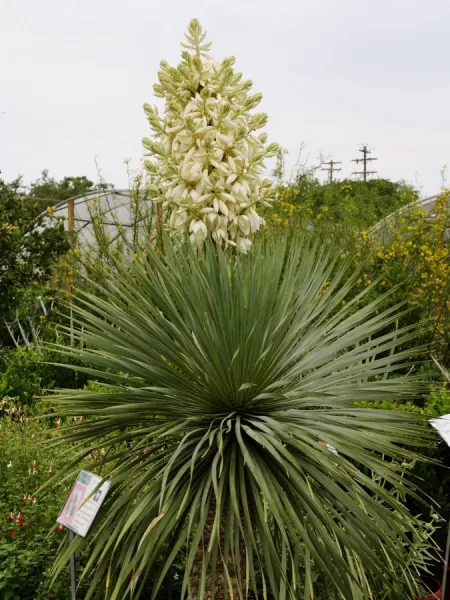
Yucca rostrata, often referred to as the Beaked Yucca, is an excellent choice for a drought tolerant landscape and or low water , low maintenance landscape design. It is a tough Texas native with silver blue foliage and forms a trunk as it matures. It is a great standalone specimen plant as well as looks architecturally defined and planted in mass. Often paired with agaves and other yuccas, the Yucca rostrata is very versatile. When designing your landscape, make sure to pair with the same water requirements to create the perfect xeriscape setting.
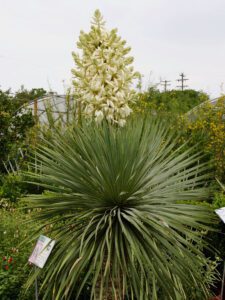
Specimen Yucca rostrata at Vivero Growers.
To create a softer look, plant it alongside perennials.
The various Salvias and Whales Tongue Agaves are a common pairing as well as low groundcovers like the Silver Ponyfoot and the Ice Plant. The addition of the perennials adds color as well as movement to the setting. You can vary the heights in your design with larger plants Tecoma stans , Esperanza or the ‘Bells of Fire’ Tecoma.
If you are looking to lower perennials, there are several options to choose from. The Skullcap, available in pink or violet, both drought tolerant and pollinator favorites, or the ever propular Salvia greggii. Another great planting combo is planting the Yucca with Ice Plant, Tecoma, Santa Rita Cactus, and mixing in some of the Texas native Muhly grasses.
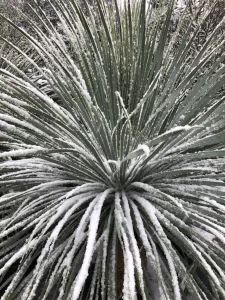 The Yucca rostrata is a tough plant, able to survive the Texas heat as well as the historic Texas snow in 2021. For optimum planting, plant in well-drained soil and or decomposed granite and water sparingly. The photo to the right shows a Yucca covered in snow here at the nursery in Austin, Texas, during the snowstorm in 2021.
The Beaked Yucca, Yucca rostrata, is a wonderful Texas native choice when designing your landscape. You can choose to trim the expired leaves and to expose the trunk, or you can leave them as “the skirt”. It is a personal preference. Either way you choose to trim or not trim the spherical shape is a beautiful accent to just about any landscape.